What did AI actually give back? Prove it without inflating it.
Every AI rollout meets the same question from finance: what did we get back? Most answers are a survey average or a vendor's estimate. Finance needs a number it can defend in the boardroom.
Aristo's Value Report answers the way a finance team would. Every figure says what kind of true it is: counted, attested by the people who did the work, or estimated with its model named. A figure Aristo cannot reach yet shows as a dash, beside the exact thing that would fill it in.
Five questions, in the order the CFO asks them
- What did the people actually get done?
- How much time came back?
- Is it causal — or would it have happened anyway?
- What did protecting the spend free for new work?
- Does the return justify expanding?
The part most reports skip: is it causal?
Time saved is easy to claim and hard to prove. So the Value Report keeps a control group. On day 0, 12% of the cold seats are set aside as a holdout that Aristo deliberately never nudges. It is read after at least 14 days, with at least 8 people on each side — and only the cautious end of the result, the lower bound of the 95% confidence interval, is ever counted as money. Until the gap clears that bar, Aristo claims no dollar from it. In its own words: nothing is proven yet — and that is the honest answer.
The same discipline runs through the whole report. Spend that was protected rather than returned is shown, labeled as an estimate, and kept off the headline figure on purpose. And the report will not recommend expanding until the control group reads: an expansion justified by a directional number is justified by nothing.
That is why its "yes" is believable when it comes.
What it looks like
This is the Value Report on a sample tenant, unretouched:
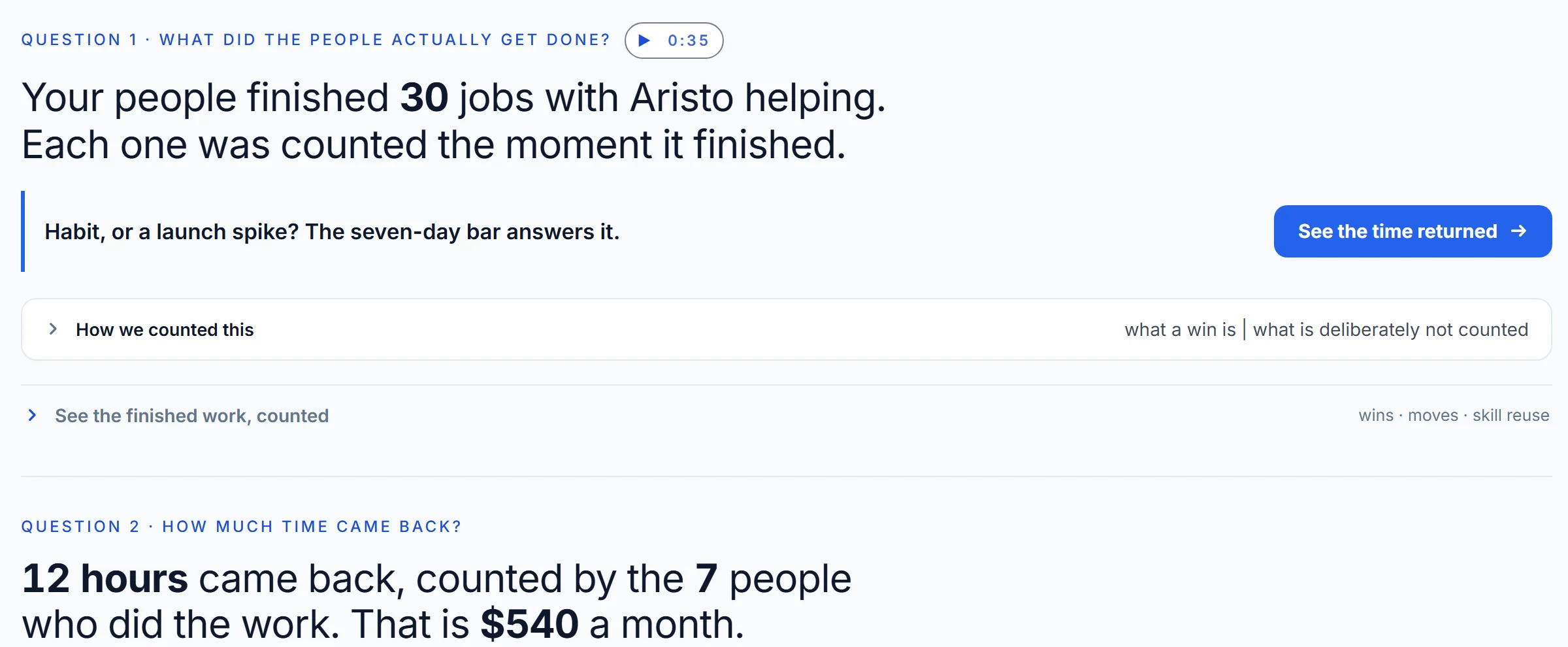
- Done: 30 jobs finished with Aristo helping, each counted the moment it finished.
- Time: 12 hours came back, counted by the 7 people who did the work — time gained minus time lost — worth $540 a month.
- Causal: not proven yet, so no dollar is claimed from it.
- Protected: another $14,082 a month was never spent — an estimate, kept off the headline on purpose.
How it lines up with Microsoft's guidance
Microsoft's 2025 Work Trend Index asks leaders to treat AI agents like any team member — onboard them, give them ownership, and measure their performance — and, when they find value, to reinvest and scale further and faster. The Value Report is that loop, with a control group behind it, so the reinvestment rests on evidence rather than enthusiasm.
For Microsoft account teams
An expansion conversation goes further when the customer's own finance team already trusts the number. The Value Report gives the customer that number, sourced line by line, and leaves as a PowerPoint deck with one slide per question — the same numbers as the page, never re-typed.
Three reports, one story
The License Report finds the money. The Frontier Firm Report turns it on. The Value Report proves what came back. All three are counted from your own tenant, through one read-only consent, and available on Azure Marketplace, billed through your Microsoft agreement.
Sources: Microsoft WorkLab, 2025: The year the Frontier Firm is born ("The path forward"). Sample-tenant figures are from Aristo's Value Report, 23 September 2026.
Published 24 September 2026 · All insights